A practical guide 8 min read / Bare Journal · No. 06 / June 2026

Five things that change in a surfer's body after forty.

Two days between sessions used to be one. The shoulders take longer to settle. None of it is weakness. All of it is physiology — named, plainly, in the order it matters.

In this guide.

  1. Anabolic resistance — why the same steak no longer rebuilds the same muscle
  2. The leucine threshold — the line the over-40 body needs to clear
  3. The paddle load — why surfing is resistance training the body reads as serious
  4. The cold-water tax — what the wetsuit doesn't fully offset
  5. The recovery window — the sixty minutes after you walk back up the sand
01— Anabolic resistance
i.The biology

The same steak no longer rebuilds the same muscle.

This is the headline fact for any surfer over forty. In a 2015 paper in Nutrition Reviews, Wall and colleagues showed that older men have a more than three-fold smaller muscle protein synthesis response to a given dose of dietary protein than younger men do. The same chicken breast, the same eggs after the session — they no longer rebuild the same amount of muscle.

The cellular machinery hasn't broken. It is simply less responsive to the input. To get the same output as you got at twenty-eight, you need a different input — either more total protein, or protein in a more leucine-dense form. There is no third option in the literature.

Wall et al. · Nutrition Reviews · 2015
The takeaway Your effort and your diet didn't change. The biological return on them did. Recognising that is the entire reframe — and it isn't an indictment, it's a fact you can work with.
02— The leucine threshold
ii.The molecular switch

Two grams of leucine. The line the body is watching for.

Of the nine essential amino acids, one matters disproportionately: leucine. Leucine acts as a master switch for muscle protein synthesis — the molecular process the body uses to repair muscle. At a particular concentration in circulation, it triggers the cascade. Below that, the cascade fires weakly.

In Katsanos and colleagues' 2006 work, young and older adults were given the same dose of essential amino acids in two leucine ratios. In the young, both worked. In the older group, only the leucine-enriched version raised muscle protein synthesis. The practical threshold the literature has settled on for adults past forty sits around two grams of leucine per meal — and most food-only meals struggle to reach it consistently.

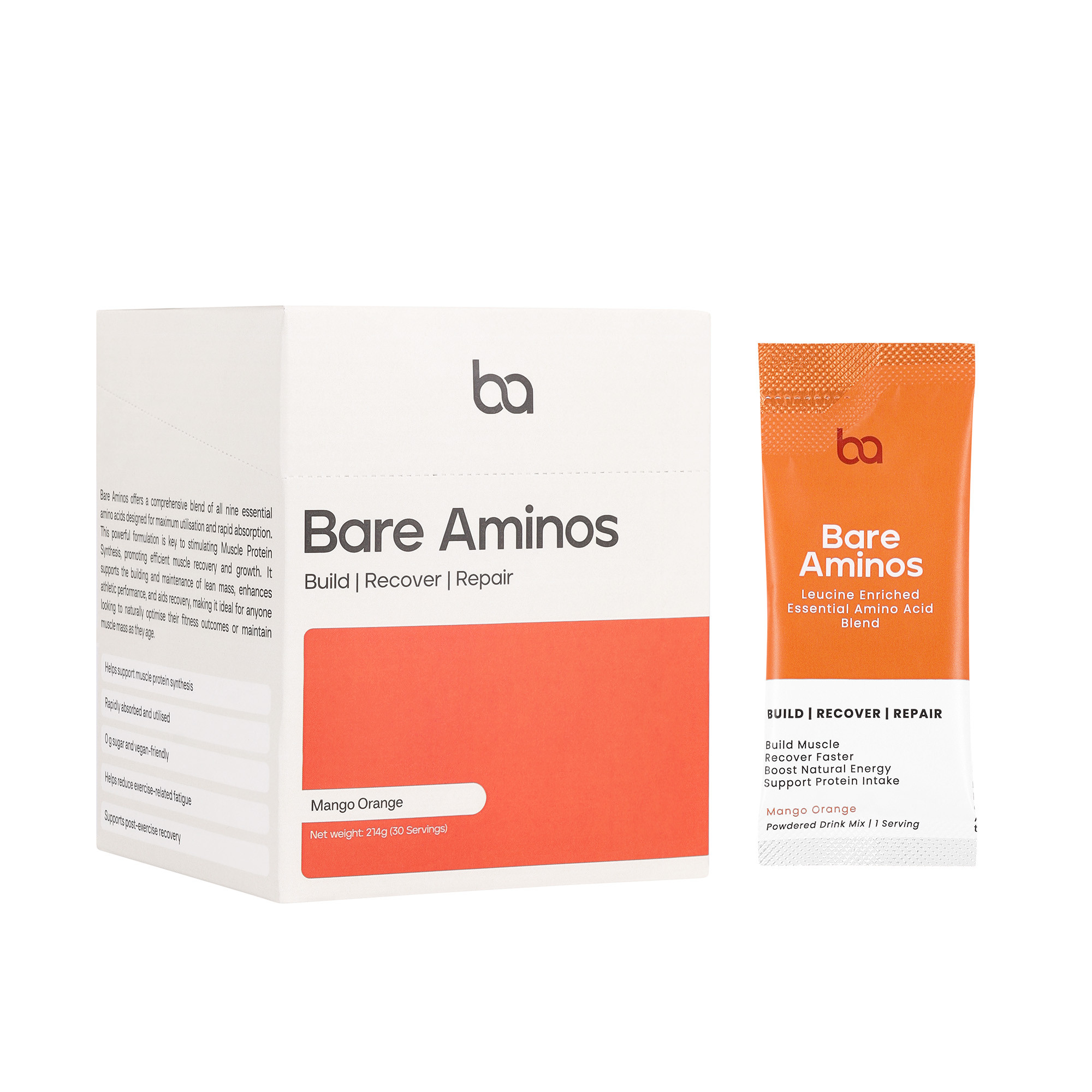
Bare Aminos delivers exactly 2g of leucine per 5g serve. Sized for the body that needs to clear the bar.

Katsanos et al. · American Journal of Physiology — Endocrinology and Metabolism · 2006
The takeaway 2g of leucine is the line. Below it, the older body's repair signal misfires. If a recovery product doesn't list its leucine content on the label, treat that as the answer to whether it clears the bar.
03— The paddle load
iii.The load profile

Surfing is resistance training.

The wellness narrative has framed surfing as lifestyle for most of the last fifty years — sunrise, salt, stoke, identity. All of that is true. There is also a quiet biological fact underneath it: a two-hour session is hundreds of paddle strokes through the lats, the rear delts, the long head of the triceps and the rotator cuff. It is forty pop-ups, each one an explosive concentric effort. It is the kind of accumulated eccentric and concentric load that produces, at the cellular level, real muscle-damage adaptation.

Upper-body eccentric work elevates myoglobin and creatine kinase — the same blood markers strength-training research uses to identify trained adaptation. The paddle is a row. The pop-up is a controlled-tempo squat through the hips and chest. The body has always read it as resistance training. It's only the supplement industry that hasn't.

The Inertia · Surfing and shoulder injuries · 2022
The takeaway Stop discounting the load. The cellular cost of a long session is in the same neighbourhood as a heavy gym session. The recovery debt is real, and the body is asking you to settle it.
04— The cold-water tax
iv.The thermal load

What the wetsuit doesn't fully offset.

If you're surfing Cape Town in the winter — Muizenberg at 14°C, Llandudno colder — or the West Coast year-round, the body is fighting two battles in every session: paddling volume and thermal load. Cold-water immersion is well-evidenced as a recovery tool over time, but in the acute window after a cold session, the body spikes cortisol and burns metabolic budget on rewarming before it can repair anything.

The 5/4 wetsuit and the hood help. They don't eliminate the load. For a surfer in Kommetjie in July, the cellular bill at the end of the session is paddle damage plus thermal cost. For the surfer in Durban in February, it's pure paddle volume hitting a body that handles eccentric damage differently at fifty than at twenty-eight. Either way, the substrate request is the same: amino acids, at the right dose, in the recovery window.

The takeaway Cold-water surfers aren't weaker — they're carrying more recovery debt per session. The amino-acid case is, if anything, stronger for the Cape Town and West Coast surfer than for the Durban one.
05— The recovery window
v.The window

The sixty minutes after you walk back up the sand.

There is a window. It is not religious — the muscle does not become unsalvageable at the sixty-first minute. But the repair signal is at its loudest in the first hour after a training stimulus, and the substrate the muscle has available in that window will determine how much of the signal gets answered.

Practically: a glass of cold water with 5g of EAAs dissolved in it, taken while you're peeling out of the wetsuit on the tailgate, lands precisely where the cascade is asking. The 2023 ISSN position stand on EAA supplementation confirms post-exercise EAAs raise net muscle protein balance in trained and ageing populations alike. The drive home is the wrong place for a whey shake. The car park is the right place for 5g of EAAs in 400ml of cold water.

Jäger et al. · ISSN Position Stand · 2023
The takeaway Keep a sachet or a pre-measured scoop in the bakkie. The car park is the slot. It is the easiest single behavioural change with a measurable physiological return.
The conclusion

Five shifts. One product built for them.

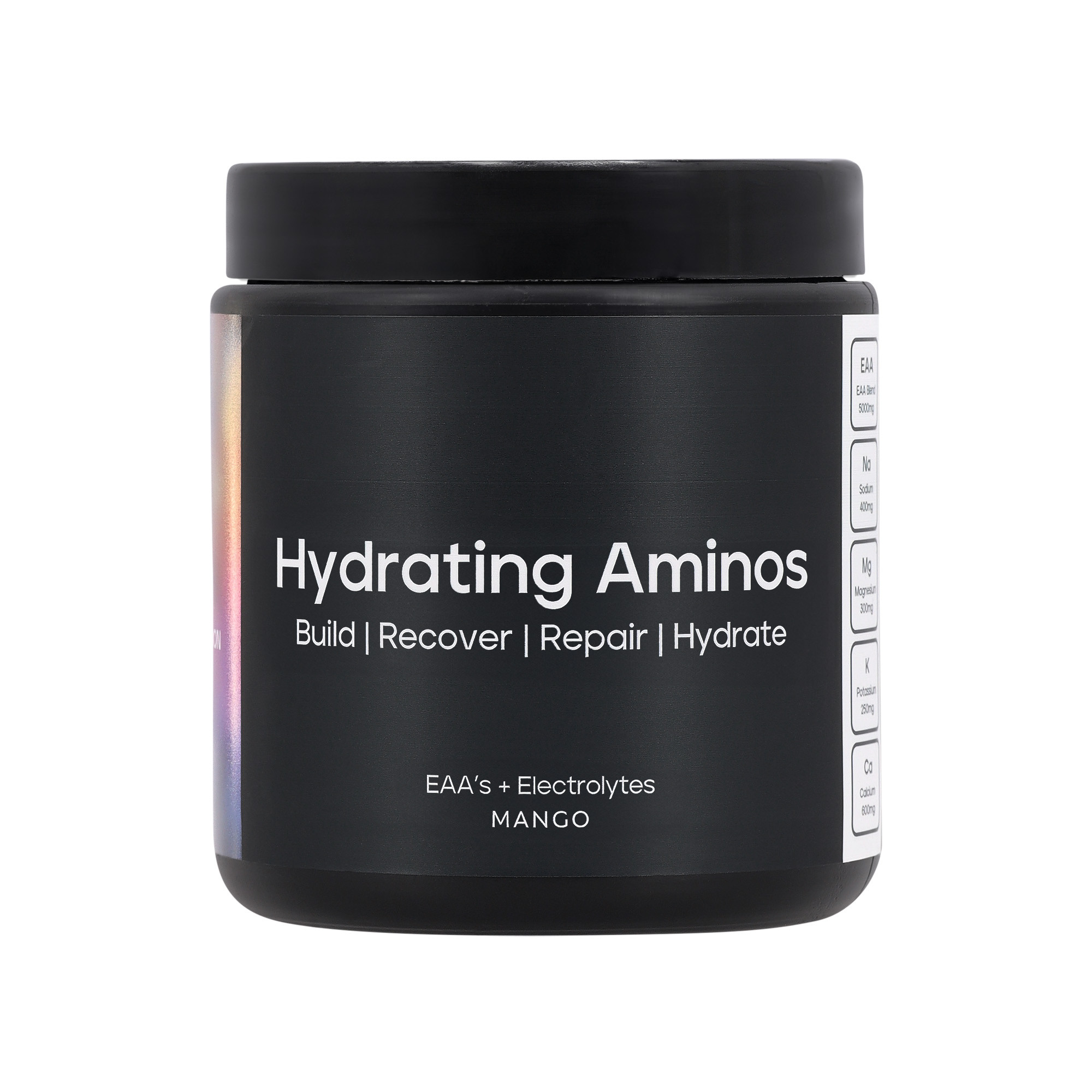
Bare Aminos answers all five. 5g of essential amino acids. 2g of leucine — over the over-40 threshold. All nine essentials. Sized for the body that still wants dawn patrol at sixty. Made in Durban. Confirmed by sports scientists.

See Bare Aminos for surfers → Or go straight to the product