An essay 6 min read / Bare Journal · No. 05 / June 2026

The flask before the paddle.

Most of what's on the SA hydration shelf was built for an athlete you aren't. An essay on why surfer physiology asks for a different number — and why the category quietly got the dose wrong.

The alarm goes off at ten to five. You are already half-awake — you have been since four. The cams say Bay of Plenty is doing something. The kettle goes on. You stand at the counter with one hand on a coffee, the other on the steel flask you fill from the tap. Maybe you drop in a Biogen tab the chemist gave your wife last winter. Maybe just water. The wetsuit is over your shoulder, the board is under your arm, the bakkie is on the verge. By 5:25 you are at the carpark.

The ritual is already there. You have done it a thousand times. The flask, the coffee, the board, the bakkie. What is missing — quietly, structurally — is the right thing in the flask. Not because you are doing it wrong. Because the SA shelf has not actually offered you the right thing yet.

What is on offer is a split aisle. Biogen and USN in the gym corner, in neon. Rehidrat in the pharmacy corner, in the same packet your kids' last gastro bug came in. Above that, in the Instagram tier, LMNT and Liquid IV — neither sold locally, both quoted constantly in the WhatsApp groups, both built for an athlete you are not.

Ch. 01The reframe

Most hydration drinks were built for desert runners.

Somewhere in the last fifteen years, the hydration category settled on a single number to compete on: sodium per serve. The benchmark was set by LMNT, which packs a full one thousand milligrams of sodium into a stick. That number is not arbitrary. It was engineered for a specific physiological problem — heavy-sweat endurance in hot, dry environments. The founder pitch was Navy SEAL trainees in the Mojave and CrossFit athletes doing two hours of work in 35-degree heat. The dose follows the problem.

The problem you have at five-thirty in the morning at Muizenberg is not the Mojave problem. It is not even close to the Mojave problem.

A surfer who paddles a 90 to 120 minute session in 16-degree water in a 4/3 wetsuit is operating in a thermal environment that runs the opposite direction. Conductive cooling from cold water moves heat out of the body roughly twenty-five times faster than air at the same temperature. Your wetsuit traps a layer of warmed water but the gradient is still toward the ocean. The thermoregulatory cascade that drives sweat onset in a runner at minute fifteen never properly arrives in the lineup. Your body is dumping heat into the Atlantic, not into evaporation.

When researchers actually measured it — Caldwell et al., 2022, two-hour sessions in male recreational surfers — they found a mean fluid loss of about 0.3 litres per hour. Land endurance work sits in the 0.8 to 1.5 range. The surfer loses roughly a third of what the runner loses, and most of even that loss is respiratory water and saltwater swallowing, not classical thermoregulatory sweat.

Less sweat means less sodium loss to replace. The biology is not controversial. The marketing is the only thing that pretends otherwise.

Caldwell et al. · PMC9017998 · 2022
Ch. 02The numbers, plainly
0.3
Litres per hour fluid loss in a two-hour surf session — Caldwell et al. 2022
1,000
Milligrams of sodium in one LMNT stick — engineered for desert endurance
450
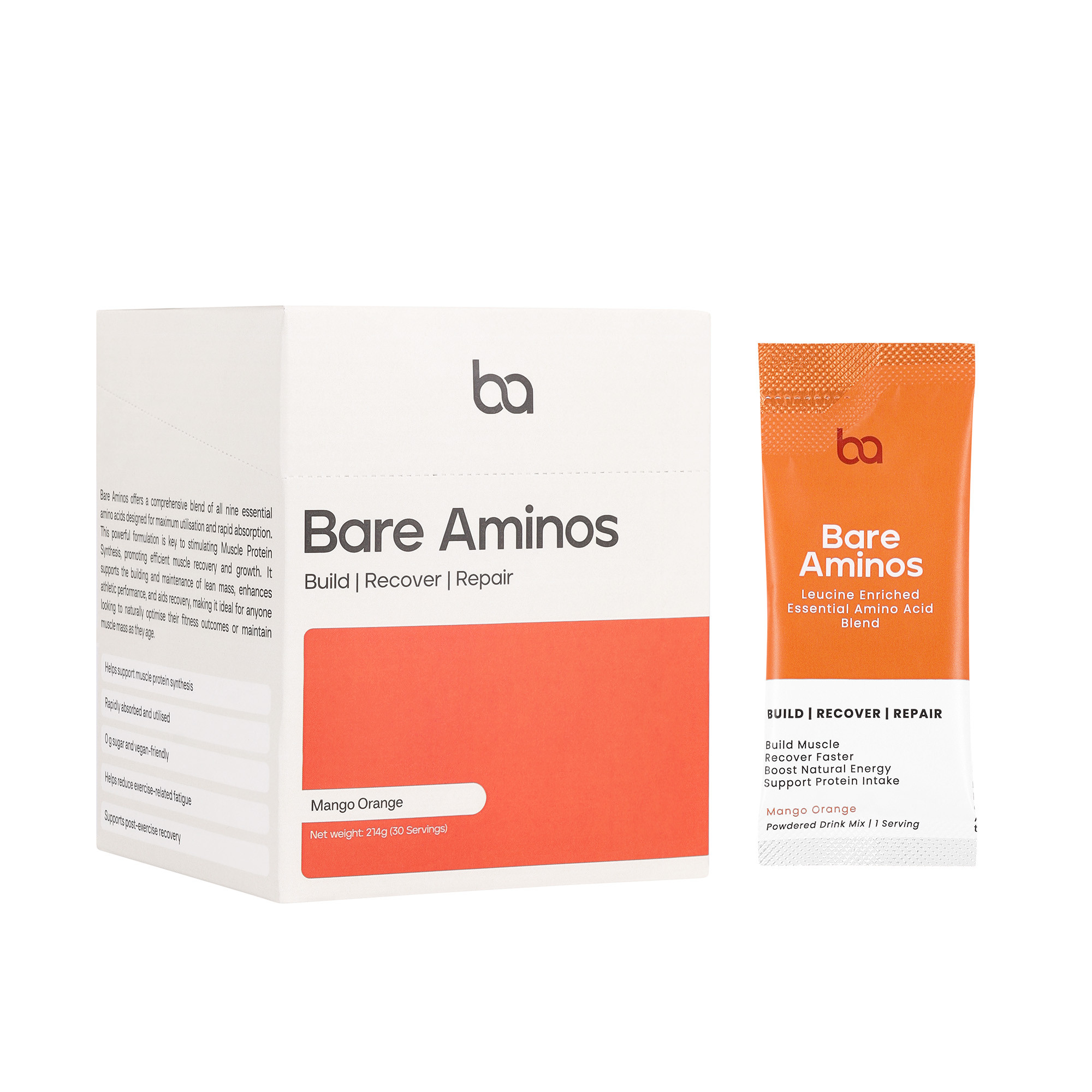
Milligrams in Bare Hydrating Aminos — inside the ACSM 300–700 mg pre-exercise band
Ch. 03The science

What the surfer is actually asking for.

Hydration is not water plus salt. Hydration is how fast water and salt cross the wall of the small intestine into circulation. This is governed by intestinal co-transport — proteins embedded in the gut wall that pull water across by pulling something else across with it.

Every commercial sports drink built since the 1970s exploits one of these pathways: sodium-glucose co-transport, run by a protein called SGLT1. Sodium and glucose are pulled across together in a fixed 2-to-1 ratio, and water follows by osmosis. This is why Gatorade has sugar — the sugar is not for energy, primarily; it is the substrate that makes the water move. The cost is a sugar load, an insulin response, and an osmolality profile that can actually delay gastric emptying if the drink is too concentrated.

What is less well known — and is the conceptual move behind a new generation of hydration products — is that sodium also co-transports with amino acids, through a different family of proteins called the SLC6 transporters. The stoichiometry on this pathway is better than glucose: a precise EAA blend can carry up to three sodium molecules per amino acid molecule, against glucose's two. The result is faster fluid uptake at lower osmolality, without the sugar.

None of this is fringe. It is published, replicated, and increasingly the foundation of formulation work in sports nutrition. What is unusual is that no South African brand has built a product around it yet.

SupplySide SJ feature · Amino-acid hydration co-transport
Ch. 04Why most hydration isn't built for this body

The sodium dose doesn't fit the man.

The high-sodium hydrators — the international leader at a thousand milligrams, the high-sugar travel hydrator at five hundred — work, in their own brief. The cellular mechanism is correct. The dose is wrong for the surfer, and the friction shows up in three places.

First, gastric load. A thousand milligrams of sodium in 500 ml of water raises osmolality enough to delay gastric emptying. You paddle out with a sloshing stomach. Second, taste fatigue. Most users of the high-sodium category dilute the drink because it is unpalatable at the dose printed on the label — which means the actual delivered dose is lower than the marketing claim anyway. Third, sodium-induced thirst overshoot. Excess sodium increases perceived thirst on a wave you cannot act on.

The pharmacy-aisle alternative — the SA effervescent tab at 180 mg of sodium — has the opposite problem. It is dosed for a child with gastro. For a 45-year-old man paddling for two hours into Bakoven swell, it is structurally under-dosed and missing the amino acid layer entirely.

"1,000 mg of sodium before a dawn patrol is a marathon dose for a surf session. The category set the bar for an athlete you aren't. The biology has been quietly asking for a different number all along."
— On the dose-to-physiology mismatch
Ch. 05The realisation

Balanced. EAA-paired. Built in Durban.

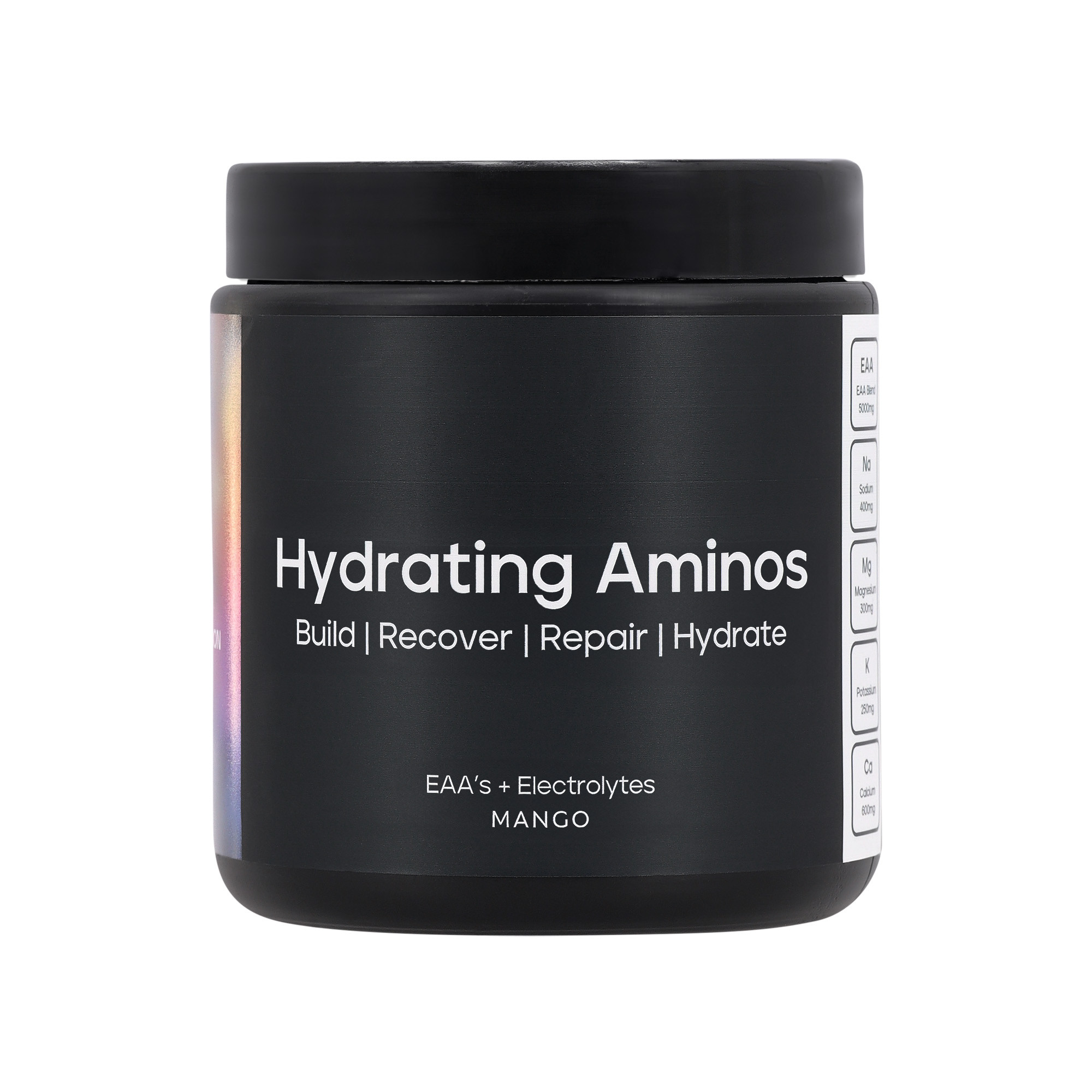
The shape that fits the practice is already implied by the science. Around 400 milligrams of sodium — inside the 300 to 700 milligram pre-exercise band the ACSM literature recommends for moderate-sweat work. 250 milligrams of potassium to handle the intracellular side of the shuttle. 300 milligrams of magnesium — a meaningful neuromuscular dose, close to the full daily requirement — and 600 milligrams of calcium for contractile and bone function. And, layered through it, five grams of essential amino acids — leucine at two grams, the threshold that initiates muscle protein synthesis even before the eccentric load arrives.

The conceptual move is not less sodium for its own sake. The move is the right amount of sodium for the right physiology, paired with the amino acid blend that opens the faster co-transport pathway and pre-loads the recovery process before the damage starts. Two jobs in one flask.

Bare Hydrating Aminos was built around this fit. Five grams of essential amino acids and a balanced electrolyte profile — sized, dosed, and formulated for the man in the wetsuit, not the man in the Mojave. Plant-fermented. Made in Durban. Sports-scientist confirmed.

Continue reading

The five drinks in your
pre-surf bottle, compared.

A side-by-side of every electrolyte drink on the SA shelf. Sodium, sugar, EAAs, surf-fit. About fifteen minutes of reading.

Read the comparison → Or skip to Hydrating Aminos →