A practical guide 8 min read / Bare Journal · No. 04 / June 2026

Five things your reformer session is actually asking for.

Recovery is not one thing. It is five specific demands the working muscle places on the body in the hour after class — and most women are answering one or two of them, at best. A numbered guide.

In this guide.

  1. The right protein shape — and why whey is the wrong tool for this body
  2. The leucine threshold — the molecular switch you're probably missing
  3. All nine essentials — why BCAAs are an incomplete answer
  4. The recovery window — the sixty minutes that actually matter
  5. The right dose for your practice — why 5g beats 30g for reformer
01— The right protein shape
i.Recovery

Your muscle is asking for amino acids.
Not necessarily for whey.

When a working muscle finishes a reformer class, it sends a chemical request. The request is for amino acids — the building blocks the muscle uses to repair the micro-damage it just accumulated. The request is not for "protein" in the abstract. It is for amino acids specifically.

Whey protein delivers amino acids alongside about 120 calories of dairy protein, the lactose that comes with it, and a thickness that sits heavy in a body that just trained at 6am before the school run. The amino acids do the job. Everything else in the scoop is friction.

The takeaway Whey is not wrong. It is over-built. The active ingredient — the amino acids — can be delivered without the bulk, the lactose, or the milkshake.
02— The leucine threshold
ii.The molecular switch

Two grams of leucine. The threshold the muscle is watching for.

Of the nine essential amino acids, one matters disproportionately for the repair signal: leucine. Leucine acts as a master switch. At a particular concentration in circulation, it triggers a signalling cascade called muscle protein synthesis (MPS) — the molecular process by which the muscle rebuilds.

The threshold, in published work on trained women, sits at roughly two grams. Reach it, and MPS fires properly. Miss it, and the cascade fires weakly. Most "BCAA" or "amino" products on the SA shelf are dosed below this threshold — typically 1 to 1.5g of leucine per serve, which gives you a partial firing of the system you were trying to engage.

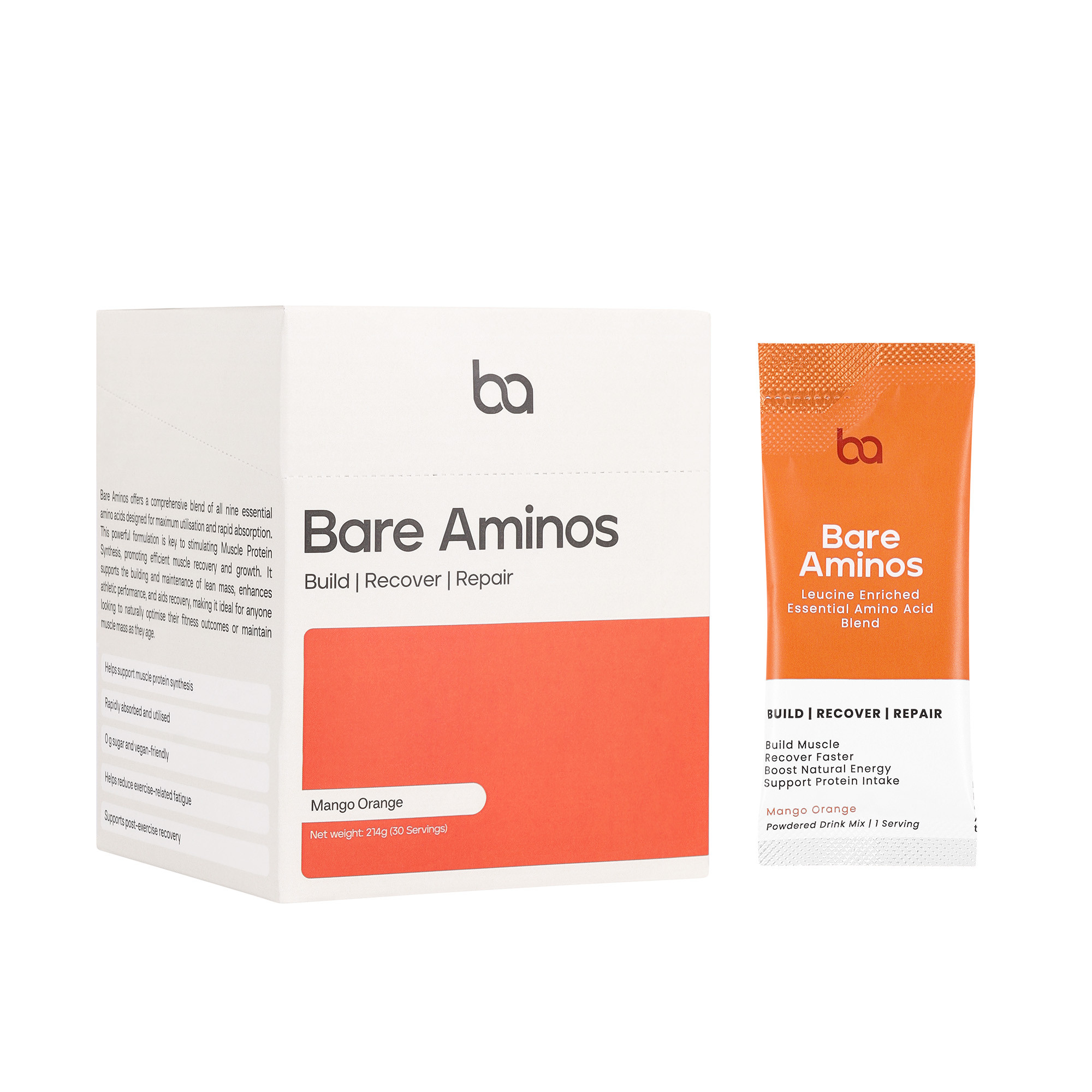
Bare Aminos is dosed at exactly 2g of leucine per serve — over the threshold, deliberately.

Moore et al. · American Journal of Clinical Nutrition · 2009
The takeaway 2g of leucine is the line. Below it, the repair signal misfires. Choose a recovery product that lists its leucine content. If it doesn't, treat that as the answer.
03— All nine essentials
iii.The complete profile

Nine essentials. Not three.

BCAAs — branched-chain amino acids — were the supplement industry's recovery story for two decades. They consist of three amino acids: leucine, isoleucine, and valine. They are essential. They are useful. They are also only one third of the answer.

Muscle protein synthesis requires all nine essential amino acids to run efficiently. If the body has leucine, isoleucine, and valine present but is short on lysine, methionine, threonine, phenylalanine, tryptophan, or histidine, the assembly line stalls at the missing piece. You get an incomplete repair.

This is why "EAAs" — essential amino acids, all nine — have replaced BCAAs in serious recovery formulas. The research now clearly favours the complete profile. Bare Aminos delivers all nine essentials at the right ratios for a 5g serve.

Wolfe · Journal of the International Society of Sports Nutrition · 2017
The takeaway If a label says "BCAA" rather than "EAA," it is dosing three out of nine. For the cost of the same scoop, you can get the full profile. Choose the full profile.
04— The recovery window
iv.The window

The sixty minutes after the carriage stops.

There is a window. It is not religious — the muscle does not become unsalvageable at the sixty-first minute. But the repair signal is at its loudest in the first hour after a training stimulus, and the substrate the muscle has available in that window will determine how much of the signal gets answered.

Practically: a glass of cold water with 5g of EAAs dissolved in it, taken while you walk back to the car or while you change at the studio, lands precisely where the repair cascade is asking. This is not a hard rule — EAAs at any point in the day still do their job — but the post-class hour is the highest-value placement.

The takeaway Keep a sachet or a pre-measured scoop in your studio bag. The walk back to the car is the slot. It is the easiest single behavioural change with a measurable physiological return.
05— The right dose for your practice
v.The dose

Five grams. Sized for the reformer.

The dose-response curve for muscle protein synthesis is not linear. There is a threshold below which the cascade fires weakly, and there is a ceiling above which additional protein delivers no further benefit. For trained women on a non-bulk programme — reformer, mat Pilates, barre, light strength — the published window for an effective post-session dose sits in the 2.5–5g leucine-equivalent range.

Anything beyond that is calorically inefficient. The 30g whey scoop is sized for a 95kg man on a hypertrophy programme. It is not the right dose for a 62kg woman whose practice asks for repair rather than mass. The over-dose is not dangerous — it is just unnecessary, and it brings calories and bulk you didn't ask for.

Bare Aminos is dosed at 5g per serve — over the MPS threshold, sized for the body and practice in question, and 100 calories lighter than the alternative.

Witard et al. · Nutrients · 2014
The takeaway More is not better past the ceiling. 5g is the smallest dose that fires the cascade properly. It is the right size for someone whose practice is precision, not volume.
The conclusion

Five demands. One product built for them.

Bare Aminos answers all five. 5g of essential amino acids. 2g of leucine. All nine essentials. Sized for the practice. Dosed for the body. Designed for the sixty-minute window after the carriage stops.

See Bare Aminos for Pilates → Or go straight to the product