An essay 6 min read / Bare Journal · No. 03 / June 2026

The shake after the reformer.

Reformer Pilates is resistance training. The muscle knew it first. An essay on what the practice is actually asking for — and why most recovery isn't built to answer it.

You finish a tower class on a Thursday morning. The lights are soft, the floor still warm from the previous group. You step off the carriage. You reach for your water bottle. Your hand shakes — visibly, briefly, the way it does when small muscles have done a lot of small repeated work. Then it passes. You smile at the instructor. You walk out into Sea Point sunlight.

That tremor was not nothing. That tremor was your stabilising muscles — the transversus, the multifidus, the gluteus medius, the deep external rotators of the shoulder — telling you they had worked. They had worked the way muscles work: through tempo-loaded eccentric contractions, through sustained isometric demand, through the kind of fibre recruitment that produces, at the cellular level, micro-damage to the working unit.

Micro-damage is not an injury. Micro-damage is the input. It is the signal that initiates the entire cascade of repair, adaptation, and what you might colloquially call "getting stronger." It is the same signal a barbell squat produces. The substrate of muscle does not know whether it was loaded by a 60kg dumbbell or a 3kg spring at the right tempo through the right range. It only knows it was loaded.

Ch. 01The reframe

Pilates is resistance training.

Somewhere in the last fifteen years, the wellness industry decided that "resistance training" meant a man in a tank top moving a barbell from the floor to over his head, and that "Pilates" meant something else — something softer, more aesthetic, less serious. This was a marketing decision, not a biological one. The muscle did not get the memo.

Resistance, in the physiological sense that matters, is any external load that causes a muscle to contract against opposition. The opposition can be gravity (a squat). It can be a barbell (a deadlift). It can be a kettlebell (a swing). It can be a spring at carriage-level on a reformer (long stretch, foot work, lunges, planks-on-the-box). The vector and the equipment differ. The cellular consequence does not.

When a reformer carriage loads the posterior chain through a controlled four-second eccentric tempo, the working muscle accumulates the same kind of micro-damage as it would under a barbell squat of equivalent intensity. When the springs hold a side-plank at end-range, the obliques and serratus anterior receive isometric tension on a duration scale that produces real adaptive demand. The reformer is unusually good at this — better than the barbell, in many cases, because the tempo is forced and the range is precise.

None of this is controversial in the strength science literature. It is only controversial in the marketing.
Ch. 02The numbers, plainly
0
Grams of essential amino acids per serve — the substrate the working muscle is asking for
0
Grams of leucine — the threshold shown to initiate muscle protein synthesis in trained women
9/9
Essentials in the profile — versus three of nine in BCAA-only formulas
Ch. 03The science

What the muscle is actually asking for.

When a working muscle accumulates micro-damage, it sends a chemical request. The request is for amino acids — specifically, the nine essential amino acids that the body cannot synthesise on its own. Of these nine, one is unusually load-bearing in the repair signal itself: leucine.

Leucine acts as a kind of master switch. At a particular concentration in circulation — clinically referenced as the "leucine threshold" — it triggers a signalling cascade called muscle protein synthesis, or MPS. MPS is the molecular process by which the muscle rebuilds and adapts. Below the threshold, the cascade fires weakly. At the threshold, it fires properly. Above the threshold, you get no further benefit.

The threshold, in published work on trained women, sits at roughly two grams of leucine. Reach it, and the muscle has what it asked for. Miss it, and the request goes partially unanswered.

Moore et al. · American Journal of Clinical Nutrition · 2009
Ch. 04Why most recovery isn't built for the practice

Whey works. It also doesn't fit.

Whey protein, the dominant recovery option, does the job at the cellular level. A 25-30g scoop of whey will deliver something in the region of 2.5g of leucine and the full essential profile alongside. The science works.

What doesn't work — for the woman whose practice is reformer at six in the morning before a school run, or barre at noon between meetings — is everything else in the scoop. Whey comes with 120 calories. With lactose. With a thickness that sits heavy in a body that just spent fifty minutes on the carriage. With a flavouring profile that drinks like a milkshake when what you wanted was something that drinks like water.

Collagen, the second most common pivot, delivers a kind of partial answer. It is well-tolerated and does support connective tissue. But its leucine content is essentially trace; it cannot trigger MPS at the threshold. It is the wrong tool for this particular repair signal.

"The substrate of muscle does not know whether it was loaded by a 60kg dumbbell or a 3kg spring at the right tempo through the right range. It only knows it was loaded."
— On the biology of the reframe
Ch. 05The realisation

Lean by design. Not bulk.

The category that fits the practice already exists. Essential amino acids — the full nine-acid profile, isolated, fermented from plant sources, delivered at the right dose. Five grams in a glass of cold water. Two grams of leucine — over the threshold. Twenty calories. No whey, no lactose, no thickness. The repair signal answered without any of the things that made whey wrong for this body and this practice.

This is the conceptual move: not less protein, not no protein, but the right amount of the right protein in the right form. The biology of the reformer was always asking for amino acids. The product category that was on offer simply didn't fit the rest of the practice.

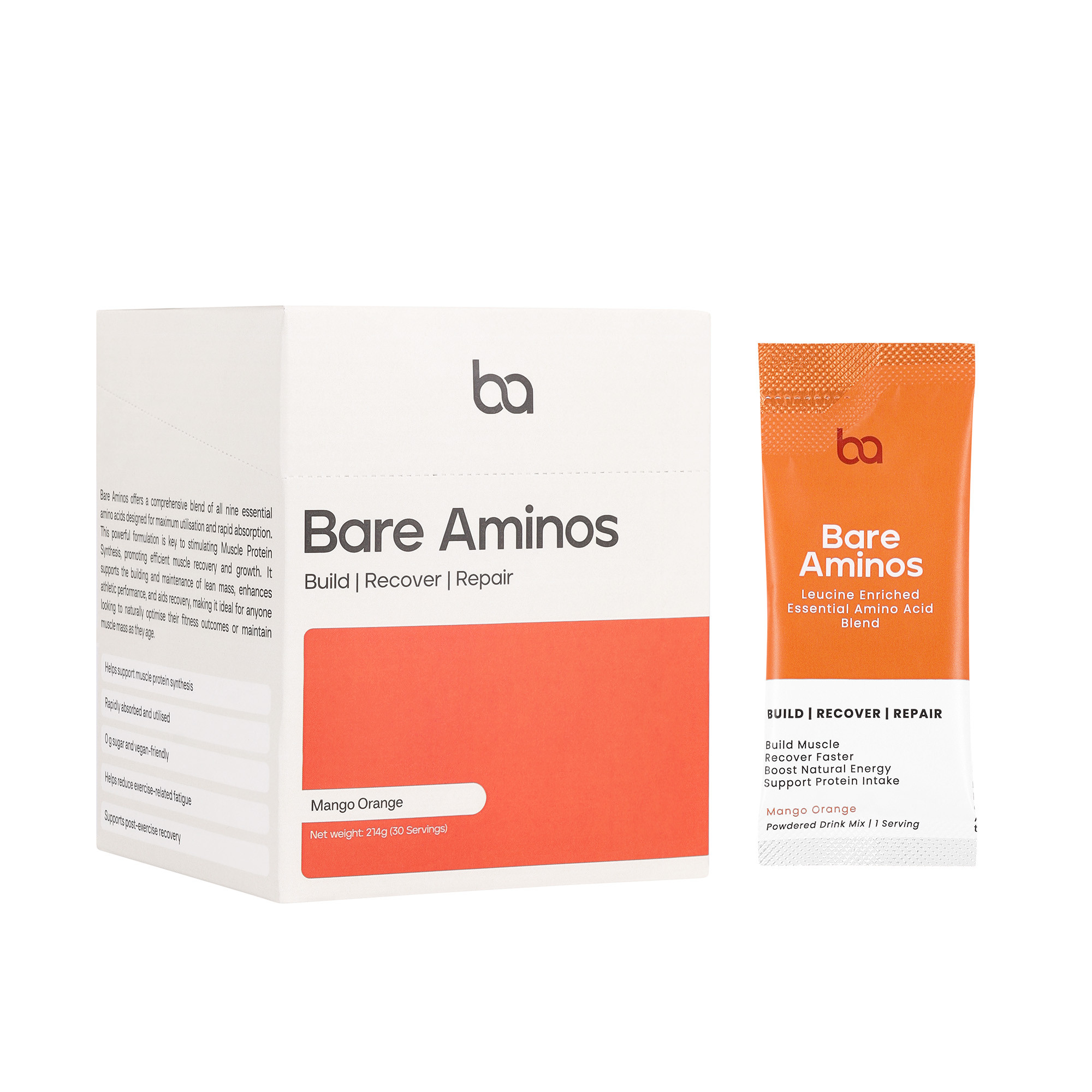
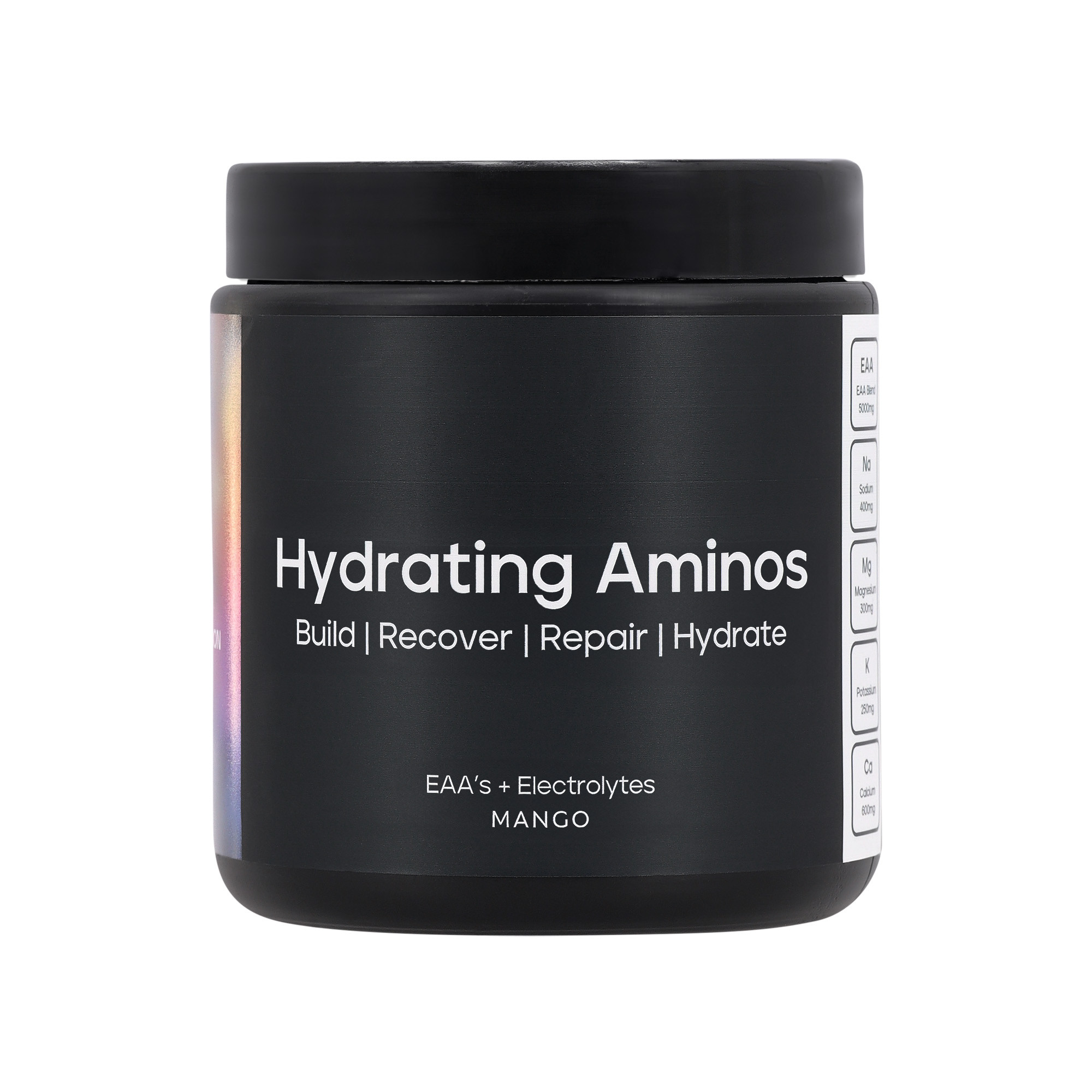
Bare Aminos was built around this fit. Five grams of essential amino acids — sized, dosed, and formulated for someone whose practice asks for repair, not bulk. Plant-fermented. Made in Durban. Sports-scientist confirmed.

Continue reading

The five things your reformer
session is actually asking for.

A practical guide, in the same plain language. Specific. Numbered. About fifteen minutes of reading.

Read the guide → Or skip to Bare Aminos for Pilates →