It's a Wednesday morning. The room is set to thirty-seven degrees. The lights are warm, the floor is matte, the mirrors are misting at the corners. You roll out a sage-green Manduka in your usual spot. The instructor counts you in. By minute forty, your hairline is wet. By minute fifty, the glass water bottle on your mat has gone from cold to room-temperature, and you're noticing — just at the edge of your attention — that your fingertips feel a little distant from your hands.
You make it through savasana. You walk out into the cooler air of the studio courtyard with the slightly elevated, slightly hollowed feeling you've come to associate with a good class. You drink the rest of the water on the drive home. By 5pm you are quietly underpowered: words slower, decisions heavier, a half-cup of coffee away from a real plan for dinner. You blame the long week. You don't blame the class.
This essay is about why you should — not in a negative sense, but in an accounting sense. There are two costs running underneath a heated practice that most of the women in the room are paying without noticing. Once they're named, they're easy to answer.
What you sweat out is more than water.
A heated yoga studio runs between thirty-two and forty-one degrees, depending on the format. The Bikram-style rooms sit at the top of that range; the infrared-heated reformer studios (HOTLATES, Reform Infrared, Drenched) tend to settle around thirty-five. Whatever the format, you sweat. The sweat is the visible signal. The invisible signal is what the sweat is carrying with it.
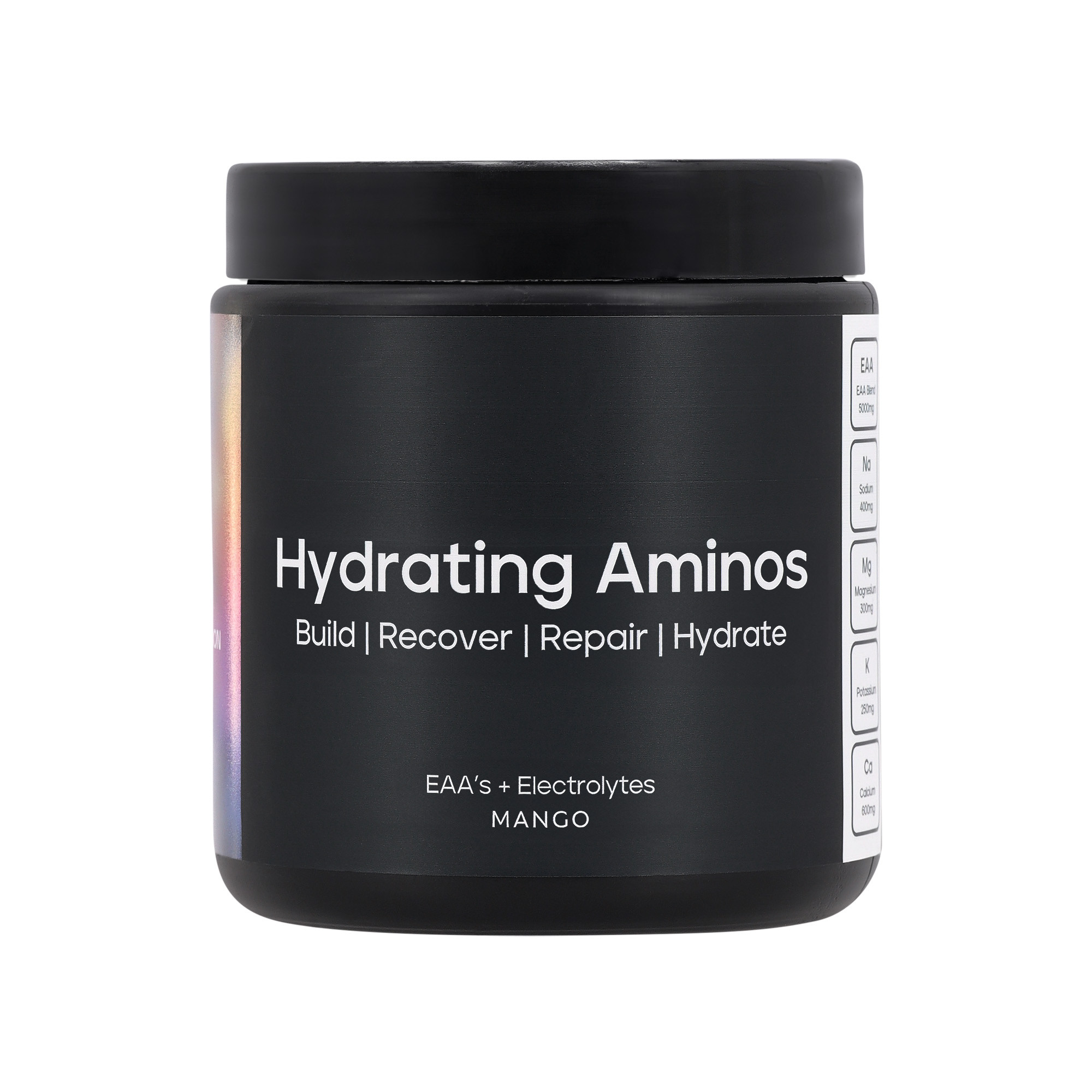
Sweat is not pure water. A litre of sweat contains, on average, five hundred to fifteen hundred milligrams of sodium, alongside potassium, magnesium, and a smaller amount of calcium. A sixty-minute heated class will commonly produce a litre to a litre-and-a-half of sweat in a 60kg woman. That is a real electrolyte loss, even though the room never asked you to lift anything heavy.
What most women drink during class is plain water. Plain water answers the volume side of the equation. It does not answer the electrolyte side. Replacing salt-and-water losses with water alone produces a mild functional dilution: the third-quarter lightheadedness, the post-class headache, the wired-but-tired evening. The published research is unambiguous on this — participants in heated yoga who replaced losses with electrolytes alongside water showed more stable hydration markers and significantly fewer symptoms of post-class dehydration than those who used water only.
Alrefai et al. · Physiological Reports · 2020 · Salt and water balance after sweat lossHot yoga is resistance training.
This is the part the wellness industry has been quiet about. Somewhere in the last fifteen years, the cultural script settled into two columns: "resistance training" was a man in a tank top moving a barbell, and "yoga" or "pilates" was something gentler, softer, less serious. The columns are marketing, not biology. The muscle did not get the memo.
A long isometric hold in a heated room — warrior two for ninety seconds, side plank held to failure, the slow drop into chair — accumulates micro-damage in the working fibre at a level comparable to a moderate resistance set. The heat raises the cost; the long durations sustain the cost. On a heated reformer, the eccentric tempo on a spring-loaded carriage adds true negative-phase loading on top of that. Both produce the same downstream signal: the muscle has been used, and the muscle is asking for the substrate to rebuild.
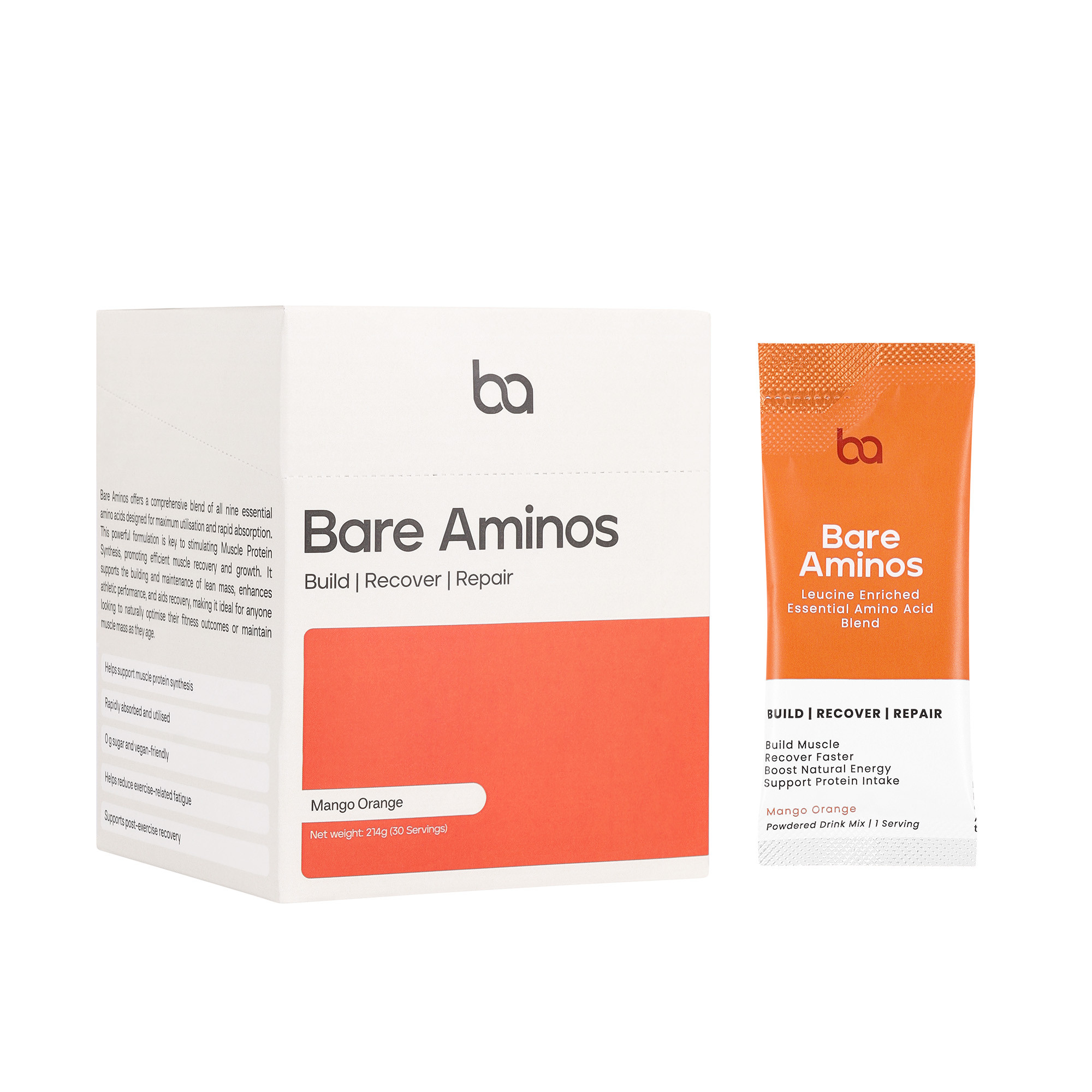
The substrate it is asking for is amino acids. Specifically, the nine essential amino acids — leucine, isoleucine, valine, lysine, methionine, phenylalanine, threonine, tryptophan, and histidine — that the body cannot manufacture on its own. Of those nine, one is unusually load-bearing in the signal itself: leucine. Leucine acts as a kind of master switch. At a particular concentration in circulation, it triggers the cascade called muscle protein synthesis — the molecular process by which the muscle rebuilds and adapts. Below the threshold, the cascade fires weakly. At the threshold, it fires properly.
The threshold, in published work on trained women, sits at roughly two grams of leucine per serve. Reach it, and the muscle has what it asked for. Miss it, and the request goes partially unanswered.
Moore et al. · American Journal of Clinical Nutrition · 2009